Introducing recruiter trust scoring
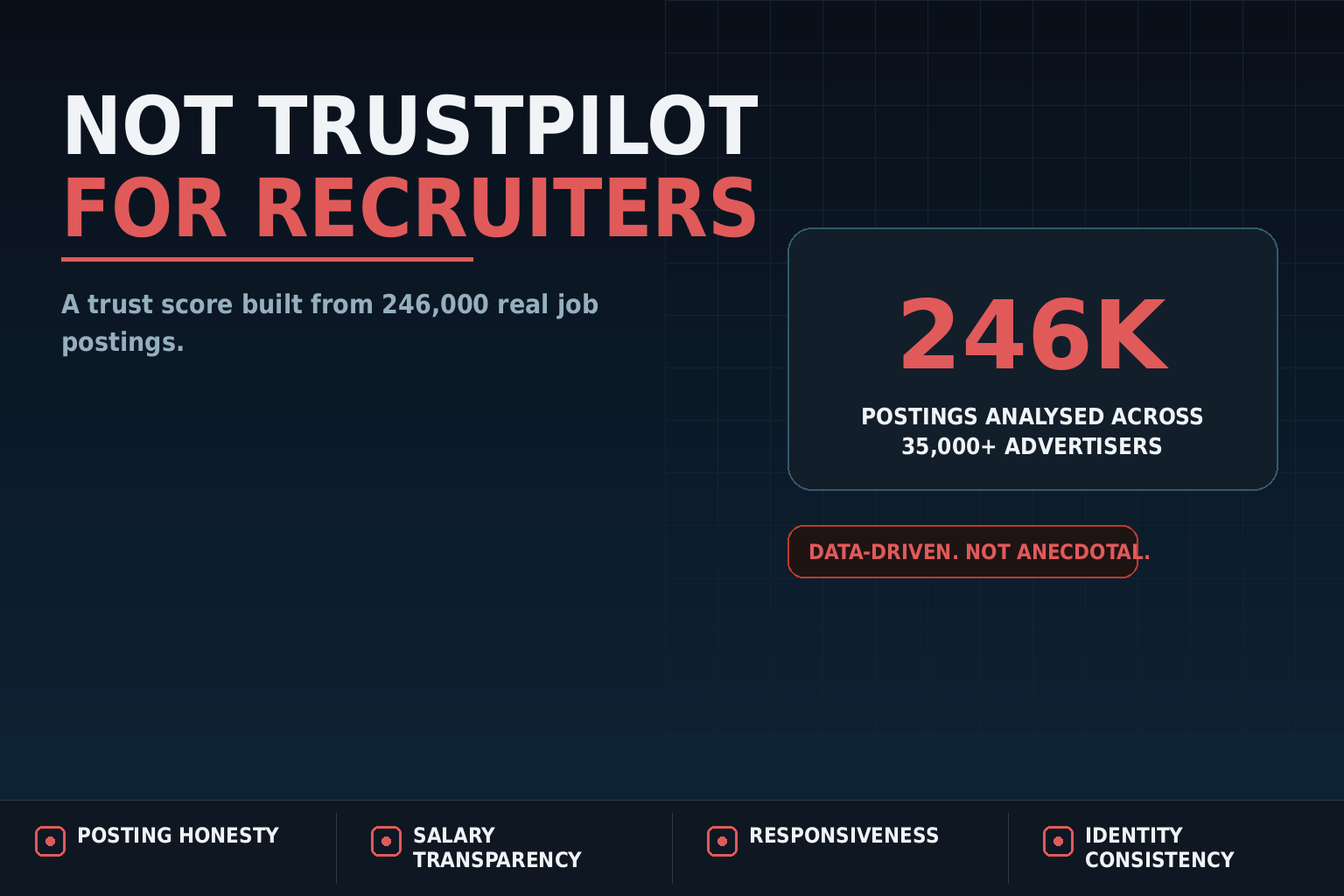
Why we're not building "Trustpilot for recruiters" — and what we're building instead
Job seekers have no equivalent of a review site for recruiters.
We think there's a better source of signal.
Why not just build "Trustpilot for recruiters"?
Star-rating platforms have real, well-known limitations. Most people never leave a review at all, so the ones who do skew toward the extremes and say little about the typical experience. Reviews are self-reported, hard to verify, and can be gamed in either direction. Critically, reviews are about the employer as a workplace, not the recruiter's conduct during hiring — a different question entirely, and the one job seekers actually need answered before they engage.
📋 Posting honesty
12.5% of repeated-title postings showed a template-reuse pattern — one case ran 164 repeats over 202 days from one location, versus the multi-branch spread a real employer shows.
💷 Salary transparency
84.7% of advertisers disclose real pay on most or all listings; only 1.4% never disclose. A measurable market norm to score against.
📞 Responsiveness
Once a candidate applies, does anything happen? The funnel-side signal we're still building out.
🪪 Identity consistency
Only around 12% of distinct advertiser names had been resolved into one clean record — the rest sit fragmented across near-duplicate spellings.
None of these require a single self-reported opinion. They're derived directly from continuously updated behavioural data, which means the score updates as behaviour changes — not once a year when someone happens to leave a review.
What this means in practice
Rather than a single number, we're building a breakdown: transparency, responsiveness, consistency, and verification, scored independently and shown together. A recruiter can be excellent on response time and weak on salary transparency — collapsing that into one star rating would hide exactly the information a job seeker needs.
🎯 An honest caveat
Behavioural signals aren't infallible. Aggregators can inflate posting counts through syndication — over 16,000 posting records in our data sit inside same-day bursts, some traced directly to syndication rather than real hiring volume. A single anomalous posting from an otherwise solid employer shouldn't tank their score. We're testing each signal against real known cases before it goes anywhere near a public number — a wrong trust score is arguably worse than no trust score at all.
Be part of building this
If you're a university careers service or a job seeker who wants to see this in action, get in touch.
👉 GetJobzi.com — Register for free